Neukölln, Kiez by Kiez
Neukölln is five inner Kieze and a large southern half that behaves like a different district. Market days, the streets that changed in 2024 and 2025, and 22 places we checked on 2 August 2026.
Neukölln is two places wearing one name. North of the S-Bahn Ring it is dense nineteenth and early twentieth-century apartment blocks. South of it, Britz, Buckow, Rudow and Gropiusstadt are village cores, garden estates and 1960s housing, and they are read wrong by anyone who arrives expecting more of the north.
Most visitors only ever see the northern half, which is four or five Kieze inside about twenty minutes of walking. This is what each one is, when its markets run, and which streets stopped taking through traffic in the last two years.
The inner Kieze
Reuterkiez runs from the Landwehrkanal down towards Sonnenallee, and it is where the canal, the market, the food street and the apartment blocks all occupy the same few hundred metres. Maybachufer and Weserstraße carry the visitors. The side streets a block back stay residential, and they stay that way even when the main ones are full.
Schillerkiez sits between Hermannstraße and Tempelhofer Feld, laid out to a 1901 plan that fixed the wide Schillerpromenade and Herrfurthplatz. It came through the Second World War nearly undamaged, which is why the street walls are continuous in a way most of Berlin's are not. The Saturday market on Herrfurthplatz and the walk out onto the old airfield are the two things that bring people in.
Rixdorf keeps the layout of the village that was here before Berlin arrived, including the protected Böhmisches Dorf and the small houses around Richardplatz. It is a working neighbourhood rather than a preserved one, and the square is somebody's route to the shops.
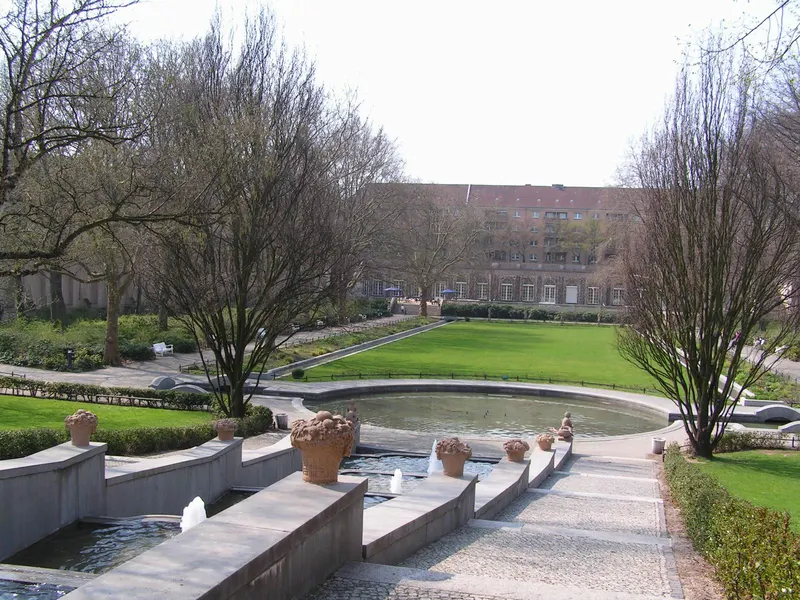
Körnerkiez is organised around Körnerpark, a sunken garden dropped into a former gravel pit, and around the schools, housing and local services either side of it. It is the one of the four with the least visitor traffic.
South of these, Britz has the Hufeisensiedlung, a 1920s modernist housing estate, and Schloss Britz next to it. Gropiusstadt is about 18,500 apartments built in the 1960s and 1970s, and is a residential district rather than a destination.
Market days
| Market | Days | Hours |
|---|---|---|
| Maybachufer, food and general | Tuesday, Friday | 11:00 to 18:30 |
| Maybachufer, textiles | Saturday | 11:00 to 17:00 |
| Schillermarkt, Herrfurthplatz | Saturday | monthly art and culture edition |
| Alt-Rixdorfer Weihnachtsmarkt | second Advent weekend | annual |
The Rixdorf Christmas market is the one worth planning around. It runs on the second Advent weekend only, and drew tens of thousands of people in 2025 into a village core with streets a few metres wide.
The streets changed, and recently
If you have an older guide, its driving and cycling directions may be wrong. Reuterkiez got one-way streets, bollards and related restrictions from late 2023, and the courts upheld the scheme in April and June 2025. The district recorded around 40 percent fewer crashes in 2024 than in 2023, with serious injuries falling from six to zero.
Schillerkiez moved from planning into construction in December 2025, with new traffic directions on Fontanestraße and Weisestraße and changes around the northern part of Herrfurthplatz. Rixdorf got traffic barriers and new directions from August 2024, on a route that had been carrying more than 4,000 cars a day across Richardplatz.
None of this affects walking. It affects cycling routes, taxi drop-offs, and any instruction that begins "drive down".
What the district is dealing with
Neukölln appears in travel writing as a nightlife district and in German reporting as something rather different. In 2024, 33.6 percent of Neukölln residents under 18 received SGB II benefits, against 23.1 percent across Berlin. Nord-Neukölln reached 40.5 percent and Gropiusstadt 37.3, while Buckow-Nord and Rudow sat below the Berlin average.
The district announced stricter controls on temporary furnished rentals inside Milieuschutz areas in May 2025, on the grounds that they reduce the housing available to permanent residents. In November 2025 it sent 9,500 questionnaires to households in Gropiusstadt, Germaniapromenade and Britz to review social preservation rules.
This is here because it changes how the place reads. The district's own visitor guide asks people to treat the inner Kieze as residential streets that happen to have bars on them, and puts legal night quiet at 22:00 to 06:00. That request has a context, and the context is above.
Places we checked
Twenty-two Neukölln places are on the map, and all twenty-two were confirmed open against a source on 2 August 2026. That is unusual. Across the whole city only 48 of 175 places have a confirmed status, and 22 of those 48 are here, because Neukölln was one of two districts researched at full depth.
The ones with the most behind them: Klunkerkranich on the roof of the Neukölln Arcaden, Tempelhofer Feld at roughly 300 hectares of former airfield, KINDL in the old brewery, the Hufeisensiedlung in Britz, and Rixdorfer Höhe, which is a hill made of war rubble. Each has its own page with opening patterns, prices where we could confirm them, accessibility notes, and the source behind every line.
Three Neukölln places we researched are not on the map, because they had closed by the time we checked: Loophole, Roamers and SchwuZ. Those are covered in the closures register, along with the one case where the sources disagree.